Operations · Web presence · Leadership · Anywhere in the U.S.
Your business has an operating system. OpsWorq makes it work.
We design how your company runs, test it before it goes live, and keep it running. Operations, web presence and fractional leadership, anywhere in the country.
Rates on the page · No contract to start · A person replies within one business day
20 min
The first conversation, free
1 business day
A person replies
$150/hr
Published. Remote work billed in 15-minute increments
0
Changes that go live untested
Start here
Where are you headed?
Pick the one that sounds most like you. We’ll show you the first step.
Something’s on fire
A key person left, a system change failed, a customer is about to walk. Call now and we’ll tell you straight what it takes.
Starting up
The cheapest time to design how a company runs is before it has ten employees. A few days of decisions now saves a year of untangling later.
Doing it all myself
You’re very good at the work, and the business is burying it: the website, the books, the vendors, the clients. One to ten people, ready to grow.
Outgrowing how we work
What worked at 12 people breaks at 30, quietly at first. The fix starts with a map of how work really moves.
15 questions, about three minutes
Getting ready to sell
Buyers pay for what they can verify. Most of the discount they’d apply can be fixed before you go to market.
Buying or merging
The seller’s numbers show what the business earned, not what it will cost to keep earning it. We look at the operation the way we’d have to run it.
More locations or franchising
The tenth location has to run like the first, without you in the room. That has to be designed and tested before it’s copied.
Stepping back
A business you can step back from is one where decisions, knowledge and relationships don’t live only in your head.
Customers can’t find us
Customers judge your operation by the part they can see: your listing, your reviews, your website and how fast you answer.
Honestly, not sure
That’s a normal answer. Twenty minutes on the phone usually sorts it out.
The idea
You make the widgets. We build the fabric.
Every business makes something: parts, care, advice, buildings, meals, software. Underneath the making is everything that lets it happen: how an order moves, who decides, where the numbers live, how the books close, which work a machine should do, what the technology runs on, and what a customer sees when they look you up.
That is the fabric. In most companies it was never designed. It grew like this:
- You added QuickBooks.
- Then Microsoft 365.
- Then a CRM.
- Then a backup system.
- Then cybersecurity.
- Then a few automations.
- Then someone built an AI workflow.
- Then three employees started keeping their own spreadsheets.
- Now nobody knows how everything fits together.
Each decision was reasonable. Nobody designed the whole machine. Now it’s what slows the widgets down.
We design it, build it, test it before it touches your business, and keep it running, so your people can spend their days on the work only they can do.
- 01How work movesYour organization designed on purpose, not as the residue of every decision before it.
- 02Standards, SOPs & policiesThe way work gets done, written down and kept current.
- 03Numbers you trustSee what’s drifting while it’s still cheap to fix.
- 04People, roles & leadershipClear roles, real ownership, fewer fires.
- 05Automation & AIThe work that shouldn’t need a person stops needing a person.
- 06Books & accounting systemsBooks that close on time, and one person who coordinates with your CPA and attorney.
- 07Finance & legal, coordinatedYour CPA and your attorney get clean numbers and one point of contact.
- 08Technology (at opsworq.net)The systems underneath, run by our managed IT team.
- 09How customers find youYour website, listings, reviews and replies, run as one system.
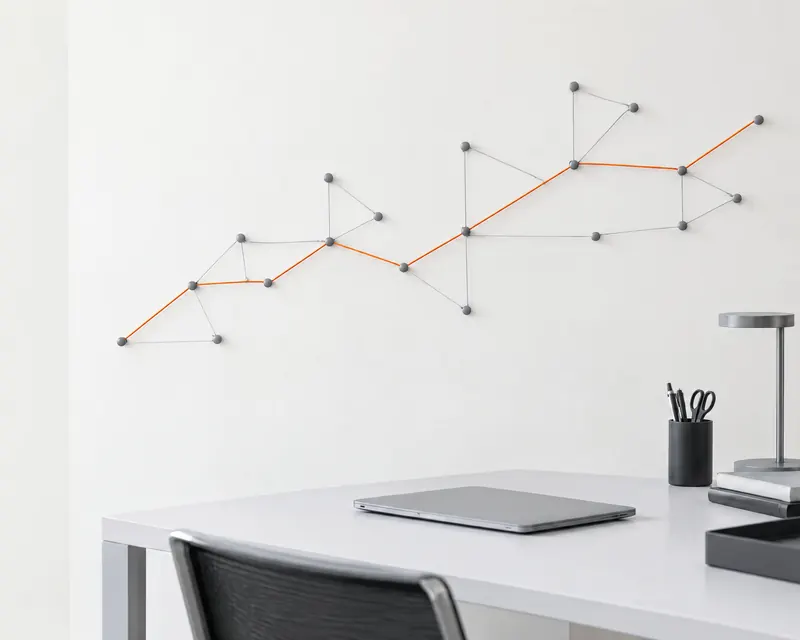
- The orange threadAccountable for the whole cloth.
Behind-the-scenes audits find where the fabric is wearing thin. Tuning keeps it right as the business changes. Audits and tuning
When it matters most
At four moments, the fabric decides.


The stakes
A national competitor can enter your market. You can’t enter theirs.
The difference is not money. Somewhere along the way they made operations a competitive advantage, and it has compounded every year since. They aren’t out-selling anybody. They’re out-operating them, and a customer only sees who was faster, clearer and easier to deal with.
Distance used to protect a local business. It mostly doesn’t anymore. A manufacturer quotes against an overseas producer; a professional firm competes with a team that never leaves its own office.
None of it requires their scale or their budget. It is design, and design is available to a thirty-person company in a way that scale never will be.
Large companies have scale. Small companies have speed.
How long a process change takes
IllustrativeA 30-person companyOne conversation, one afternoon
A 30,000-person companyMonths of meetings, approvals, integration and training
The same change, drawn to one scale.
We’ll make your company more capable of responding. That’s organizational velocity.
How we work
Six stages. One test gate. Then it repeats.
- 01 Discover
How the work actually moves, not what the org chart says.
- 02 Design
Whether each process should exist before anyone automates it.
- 03 Build
The procedures, systems and tools the design calls for.
- The test gate
Piloted, run beside the old way, or checked away from live work.
- 04 Connect
Information flowing between departments, not just between systems.
- 05 Operate
We stay in it: measuring, maintaining, documenting.
- 06 Evolve
Correcting the heading as the business changes.
The cycle repeats. The system is never finished.
What happens in each stageOur internal standard
Find the $5 problem before it becomes a $5 million problem.
Leak
The same data, entered twice
Leak
A handoff nobody owns
Leak
A $50-a-month service nobody uses
What does one leak cost you?
$6,240a year
139 hours a year, gone to one repeated task.
Your numbers. An estimate, not a quote. Fifty-two weeks a year.
None of these is worth interrupting the business for. Thousands of them compound.
What you get
An Operational Map of how your business really runs.
Fifteen questions, about three minutes, no technical knowledge needed. You get your Operational Velocity Index and your two weakest domains before you give us anything.
- 38
Information Flow You cannot see your own operation in useful time, and the same fact disagrees with itself across systems. Every decision made on top of that inherits the error.
- 41
Systems & Tools Systems have accumulated rather than been chosen, and people are doing the integration by hand. This is the most expensive kind of quiet waste.
- 79
Change Readiness The organization can absorb change, which is the single greatest predictor of whether the rest of the work will hold. This one is a strength, and it is the reason the other two are fixable.
The free version gives you the shape. The full map traces the paths work actually takes through your business, names the dependencies and prices the leaks.
What your customers see
Customers inspect your operation from the outside.
They can’t see your procedures. They can see last year’s holiday hours, a review nobody answered and a form that never replied. We run the whole public surface as one system: your website, map listings, directories, reviews and social accounts.
- FoundSearching, asking a map, asking an assistant
- JudgedDeciding whether you’re credible
- ChosenTrying to act
- AnsweredWaiting to hear back
Pricing
Pay the way the work is shaped.
$150 an hour · $225 after hours, weekends and holidays
Hourly
$300 an hour, from 8 hours a month ($2,400)
Fractional COO or CIO
Quoted per client, fixed in writing
Projects
From $1,500 a month (10 hours)
Operations partnership
For the right engagement
Fee follows the result
We don’t take on work we can’t see paying for itself. If we can’t, we’ll tell you.
Every rate, every termWhat’s different
We start where the others stop.
Consulting usually ends with a report. Agencies usually end with a launch. IT firms usually stop at the network. We start where those stop: with how the whole business runs, and we stay until it runs that way.
- Maps how the whole business actually works
- Asks whether a process should exist before automating it
- Builds what it recommends
- Tests every change before it goes live
- Runs it afterwards and reports on it
- Publishes its rates
- One party accountable for the whole thing
The principals
The people who lead every engagement.
Principal
Mark Champion, MCSE
Infrastructure, security and technology architecture, at institutional and enterprise scale. Nothing fails in isolation.
- MCSE
- Security+
- Network+
- A+
- Project+
Principal
Jennifer Bailey, MS
Industrial-organizational psychology, applied in regulated care, finance and public institutions. Broken systems are a people problem first.
- M.S. Psychology
- QuickBooks Certified
- Intuit Bookkeeping
- Intuit Tax Level 1
No client of ours has gone out of business over an operational failure we were responsible for.
Meet the principalsOn the record
Everything here can be checked.
Field Notes
Straight answers about running a business.



Read us first when you search.
GoogleAdd OpsWorq as a preferred sourceTalk to us
Tell us what isn’t working.
A sentence is plenty. A person replies within one business day.
1‑855‑OPSWORQ855‑677‑9677 · Mon–Fri, 8am–5pm ET
Sent. Thank you.
A person replies within one business day. Nothing is sold, and you’re not added to a mailing list.